Tough Bonds" to last a Lifetime
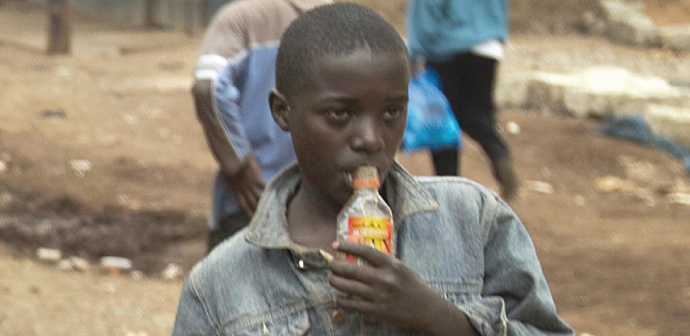
At the Chini ya Mnazi (Beneath the Palm Tree) clearing, half-buried rubber tires serve as seats and a drowsy litter of puppies are sprawled on the ground; their tiny black noses level with the scorched earth and the assorted footwear of a loud card-playing group of homeless men. Never mind that the “mnazi” is actually a 30-meter high mast street light and that garbage rims the edges of the clearing in Huruma’s Kia Maiko area. This is their sanctuary. Sitting a short distance from the noisy players are Anthony “Anto” Irungu and Ezrah Maina. They are reformed glue huffers and leading voices in the new street life documentary, “Tough Bonds”. “I’m thankful to God for having brought the team here.
We’re now able to take a new step in our lives,” shares Anto who’d been sniffing glue for 25 years having began at age six. With a cap on his head to protect his bad eye from the sun, Anto speaks in an arresting drawl. It is his voice that can be heard during the opening sequence of the four-year-long labour of love by US-based Directors Austin Peck and Anneliese Vandenberg. The idea of the film occurred to the pair during a 2009 relief food mission in Isiolo. Austin and Anneliese observed a disturbing trend of relief food dependency in the community which often led to disempowerment and fractured families, ergo, runaways who eventually lived on the streets. Their resulting feature-length documentary, “Tough Bonds” follows kids in Nairobi and Isiolo who are crippled by glue-huffing addictions and a longing for home and kin.
“If we didn’t make [it], or do it in the way that we did, the kids we followed would remain voiceless in their communities or, even worse, just continue to be depicted as helpless little victims without dignity, brilliance, immeasurable compassion. [Important] questions would not be asked and we would become people who were aware of an unacceptable reality but do nothing about it,” says Venderberg.Anthony could not agree more. He says,“We wanted the NGOs that give our government money to know that the money doesn’t reach the grassroots ...This was our way of poking the government and telling them that this isn’t life.” And in order to fully capture the day-to-day existence of its subjects, the docu-makers had to completely immerse themselves in their harsh natural habitats. Anto and Ezrah recall spending day and night with the team at Chini ya Mnazi (where as many as 50 people often hang out and sometimes slept). They also took them around to all their favorite haunts. But it wasn’t always easy going. Vandenberg explains, “The hardest days were spent in the dumps, both physically and emotionally.
Our gear, our clothes, our skin would be coated in the most foul-smelling filth any of us had ever experienced. The real impact is when you consciously process that people live there, actually live there, all of their lives, and perhaps don’t know any other life.” Ezrah, who took two years to shake off his glue huffing habits, feels that being ostracized and finding no alternatives to street life is what had them stuck in a vicious cycle. “When you are on drugs, there’s no way the community can accept you. And in this area, there aren’t even youth centres or social halls where we can keep ourselves busy. Even when we go to the neighbouring areas, we find that they are closed,” he states. Interestingly, the film crew encountered resistance from angry bystanders in and around the kids’ neighborhoods while shooting the documentary. But with a 2007 report by Consortium of Street Children (CSC) estimating that there are more than 60,000 street children in Nairobi, something has got to give.
Nairobi, something has got to give. The positive result of the film seems to be that the street children themselves are working their way out of a life of drugs and poverty. Anto and Ezrah say that as a result of being in the documentary, they formed G.U.L.L.Y (Get to Unite Living Livity) Side Self-Help Group in 2012. The current 36-member society has purchased two hand-carts which they use to collect garbage at a fee and save KES 50 every Sunday towards new group investments. And there’s only one “Gully Side” rule: No drugs. “We saw that there is no way we can have a registered self help group and still sniff glue. We had to reform,” says Ezrah, who is the group’s Assistant Secretary. And they have big plans too. “If we got a little help, we’d like to buy a printing machine to print t-shirts and a tank so that we can start a car wash business. We’d also like to open a dhobi [informal laundromat]. You know, there are many bachelors here,” Anto jokingly states. He is currently the group’s Chairman.
It would seem that “Tough Bonds” has become much more than just a film project; Austin and Anneliese also took a lot away from the film. They confess to having numerous personal revelations along the way. “The truth of interconnectedness is the single most profound outcome of making this film. We learned a great deal about compassion and courage in the most unlikely places, from the people who have been given no authority, respect or acknowledgment by their own communities. It really shook up the paradigm of where wisdom lives,” Vandenberg said.
Village Beat hopes to screen “Tough Bonds” in Kenya later in the year although the film has already begun making rounds at international film festivals and community tours. Watch the film’s trailer at Vimeo.com/VillageBeat Visit www.villagebeat.org for more information.
| < Prev |
|---|
By Wanjeri Gakuru


LATEST EVENTS
AROUND THE WEB


